
Hair Transplant Turkey: How Many Grafts Do You Really Need?
There is no universal graft number for a hair transplant. Here's how doctors assess your hair loss, donor supply, hairline and long-term goals before deciding how many grafts you actually need.
Most people researching a hair transplant in Turkey eventually ask the same question: "How many grafts will I need?"
It sounds like it should have a simple answer. You might see clinics advertising 2,500, 3,000 or even 5,000-graft packages, and it is tempting to assume that more grafts automatically means a better result.
It doesn't.
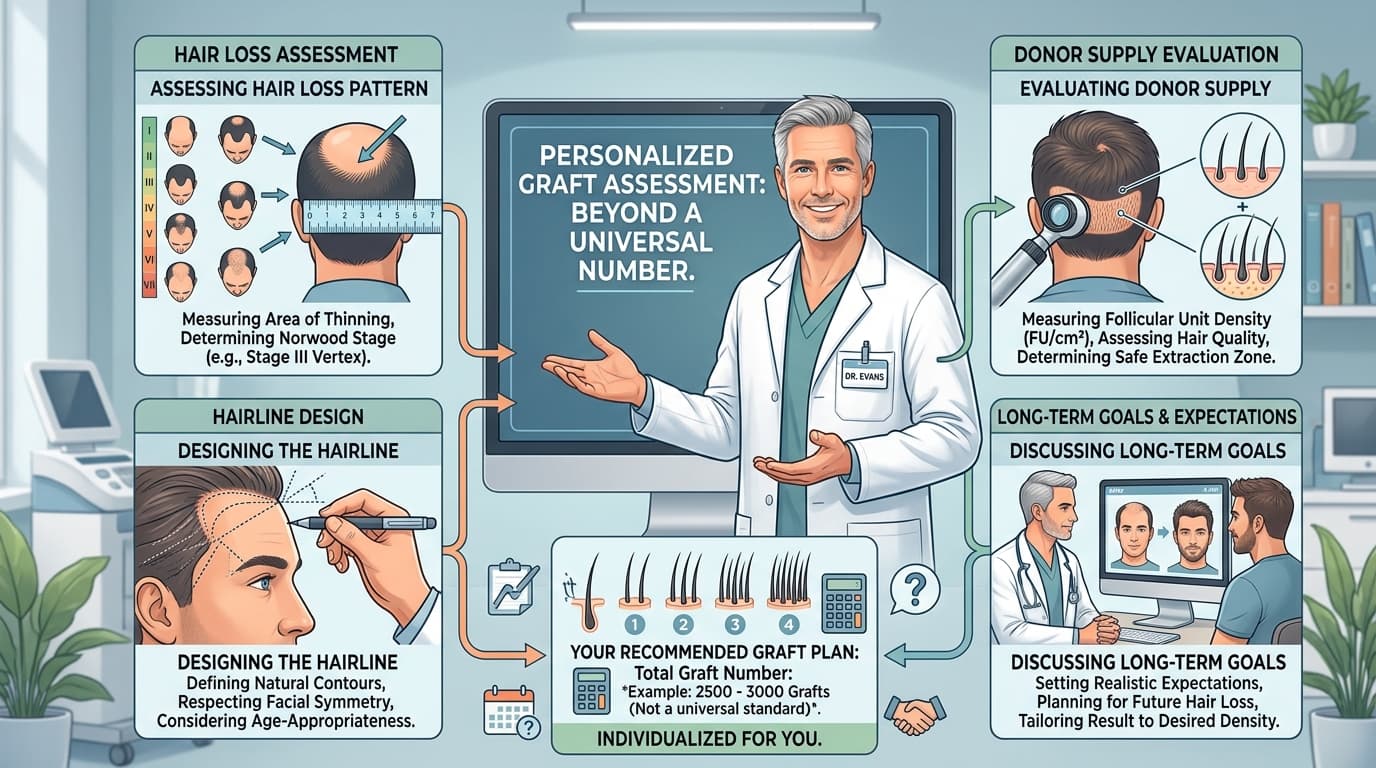
The right number depends on your pattern of hair loss, the size of the area being treated, the density of your existing hair, the quality of your donor area and, importantly, how your hair may continue to change in the future.
Two people with a similar-looking hairline can need very different treatment plans. Even patients with the same hair-loss classification may have different graft requirements because head size, donor density, miniaturisation and treatment goals are not identical.
What exactly is a graft?
A graft is a small unit of tissue containing one or more hair follicles.
This is important because 3,000 grafts does not mean 3,000 individual hairs. Depending on the graft, there may be one, two, three or sometimes more hairs growing from that follicular unit.
During a consultation, the doctor should therefore look at both the number of grafts required and the characteristics of those grafts — particularly when designing the hairline and deciding where density matters most.
So, how many grafts do you actually need?
There is no single number that applies to everyone.
As a general planning principle, the doctor will look at several areas:
1. The size of your hair-loss area
A patient with mild temple recession may need a relatively small treatment area.
Someone with significant frontal and mid-scalp loss may require considerably more grafts to create useful coverage.
The objective isn't simply to fill every visible empty space. A good plan has to balance coverage with the amount of donor hair available.
2. Your existing hair density
The amount of native hair you still have makes a major difference.
If you have reasonable density behind the hairline, the transplanted grafts can be used strategically to restore the front and improve the overall appearance without trying to recreate the density of your teenage years.
If the existing hair is already very thin, the plan may need to cover a larger area or prioritise certain zones.
3. Your donor area
The donor area — usually the back and sides of the scalp — is effectively your available supply of transplantable hair.
And that supply is not unlimited.
This is one of the reasons choosing a clinic purely because it promises a very high graft number can be a mistake. Excessive harvesting can damage the donor area and may reduce your options if you need another procedure in the future.
A responsible treatment plan should therefore consider not only what can be transplanted today, but what your donor area may need to support in the future.
4. Your hairline design
The hairline is one of the most visible parts of a hair transplant.
It isn't simply a matter of drawing a straight line across the forehead and filling it with grafts. The position, shape, angle and density all influence whether the result looks natural.
Doctors also need to consider your age, facial proportions and the possibility of continued native hair loss.
A hairline that looks impressive immediately after surgery may not look appropriate years later if the surrounding native hair continues to thin.
5. Your long-term hair-loss pattern
This is the part that is often missed in online quotes.
A transplant moves existing hair follicles from one part of the scalp to another. It doesn't stop other, non-transplanted hair from thinning.
The NHS notes that hair can continue to thin around transplanted areas, which is why the design of the transplant needs to account for how your hair may change over time.
That means the best plan isn't necessarily the one that uses the maximum number of grafts available.
Sometimes using fewer grafts more strategically is the better long-term decision.
Why "maximum grafts" isn't always better
It is easy to see a large graft number as a selling point.
But hair transplantation is not a competition to see who can transplant the most follicles in one session.
Overharvesting the donor area can create visible thinning or scarring and can leave fewer options for future treatment. The donor area needs to be managed as a limited resource.
The recipient area matters too. Grafts need to be placed at appropriate angles, directions and densities so that they blend with the surrounding native hair rather than looking artificially dense or uniform.
This is why a consultation should focus on why a particular number of grafts has been recommended, rather than simply whether the number is high or low.
What should happen during a proper consultation?
Before agreeing to treatment, you should expect a personalised assessment rather than a generic WhatsApp quote.
A doctor should assess:
Your current pattern of hair loss
The density and quality of your donor area
The area you want to restore
Your existing native hair
Your hairline and facial proportions
Your likely future hair-loss pattern
Your expectations for density and coverage
Whether one procedure is likely to be enough
UK and Turkish medical organisations have specifically recommended that patients travelling to Türkiye for hair transplantation have a consultation with the doctor who will perform the procedure, including discussion of the recommended number of follicular units and hairline design.
That is a much more useful conversation than simply being told: "You need 4,000 grafts."
Can you get an accurate graft estimate from photos?
Photos can be a useful starting point.
A clinic can often assess the general pattern of your hair loss from clear photographs and give you an initial estimate.
But photographs have limitations.
They don't always show donor density, miniaturisation or scalp characteristics accurately enough to make a final surgical plan. A proper assessment should therefore happen before the final number of grafts is confirmed.
If a clinic gives you an unusually precise graft number within minutes of receiving a few photographs — without asking questions about your donor area, medical history or long-term goals — it is reasonable to ask how that number was calculated.
What questions should you ask a hair transplant clinic?
Before booking your treatment in Turkey, ask:
1. Why do I need this number of grafts?
The clinic should be able to explain the reasoning rather than simply giving you a package number.
2. How much donor hair do I have available?
Your donor area needs to be assessed as part of the long-term plan.
3. Who will design my hairline?
Hairline design is an important part of achieving a natural-looking result.
4. Who will actually perform the procedure?
Ask whether the doctor or technicians will perform each stage of the surgery. UK and Turkish professional organisations recommend that patients are clearly informed about who will carry out the surgical steps.
5. What happens if my native hair continues to thin?
A good treatment plan should consider future hair loss, not just today's appearance.
6. Can I see 12-month results from patients with a similar pattern to mine?
Three- or six-month photographs can be useful, but they don't show the finished result. The NHS notes that full results may take around 10 to 18 months to become apparent.
The right graft number is the one that makes sense for your case
There is no magic number of grafts that guarantees a good hair transplant.
A successful plan balances coverage, density, hairline design, donor availability and future hair loss.
For one patient, that may mean concentrating grafts around the frontal third. For another, it may mean restoring both the hairline and mid-scalp. In some cases, preserving donor capacity for a possible future procedure is more sensible than using every available graft in one session.
The number matters — but the reasoning behind the number matters more.
Thinking about a hair transplant in Turkey? Speak to the Bintez team for a free, no-obligation consultation. We can review your hair-loss pattern, discuss your likely graft requirements and explain what your treatment journey could look like before you commit to anything.
Related Treatments

Hair Transplant
Permanent hair restoration solutions using advanced transplant techniques. FUT and FUE options available.

PRP Treatment
Natural hair loss solution using your own blood plasma. Quick, non-surgical procedure with minimal recovery time.
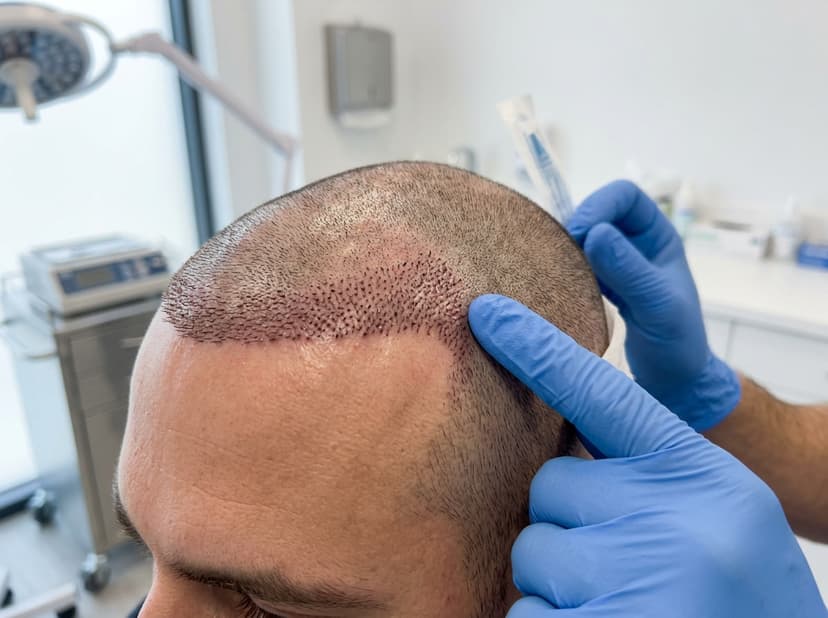
FUE Hair Transplant
Advanced follicular unit extraction technique for natural-looking hair restoration with minimal downtime.
Related Articles

Hair Transplant Recovery in Turkey: A Week-by-Week Timeline
A realistic week-by-week look at hair transplant recovery in Turkey — from the first 72 hours in Istanbul to the 12-month result, including the shedding phase nobody warns you about.

Hair Transplant Turkey Cost: What UK Patients Really Pay in 2026
UK clinics often charge by the graft. Turkish clinics usually quote an all-inclusive package. Here's how the real numbers compare.
Hair Transplant in Turkey: FUE vs DHI Explained
The two techniques you'll see mentioned most often — FUE and DHI — differ in more than just the acronym. Here's what actually separates them.